Does llms.txt Actually Work? What 300,000 Domains Reveal
Does llms.txt actually work?
Based on the data so far: it doesn’t measurably increase AI citations. Multiple independent studies in 2025–2026 found no citation advantage from having the file.
So should I skip it?
Not necessarily. It has real uses for AI developer tools and no known downside. Treat it as low-effort future-proofing — not a citation hack.
What actually drives AI citations?
Topical depth and content quality. Being the most credible, well-structured source on a topic beats any metadata file.
I’ll be honest: I added an llms.txt file to one of my sites months ago, fully expecting to see something shift in how AI tools referenced it. I checked the logs a few weeks later. Almost nothing had touched the file.
That sent me down a rabbit hole of reading every study I could find. And the picture that emerged is more interesting — and more useful — than a simple yes or no.
So let’s actually look at what the data says, instead of repeating the hype.
What the Studies Actually Found
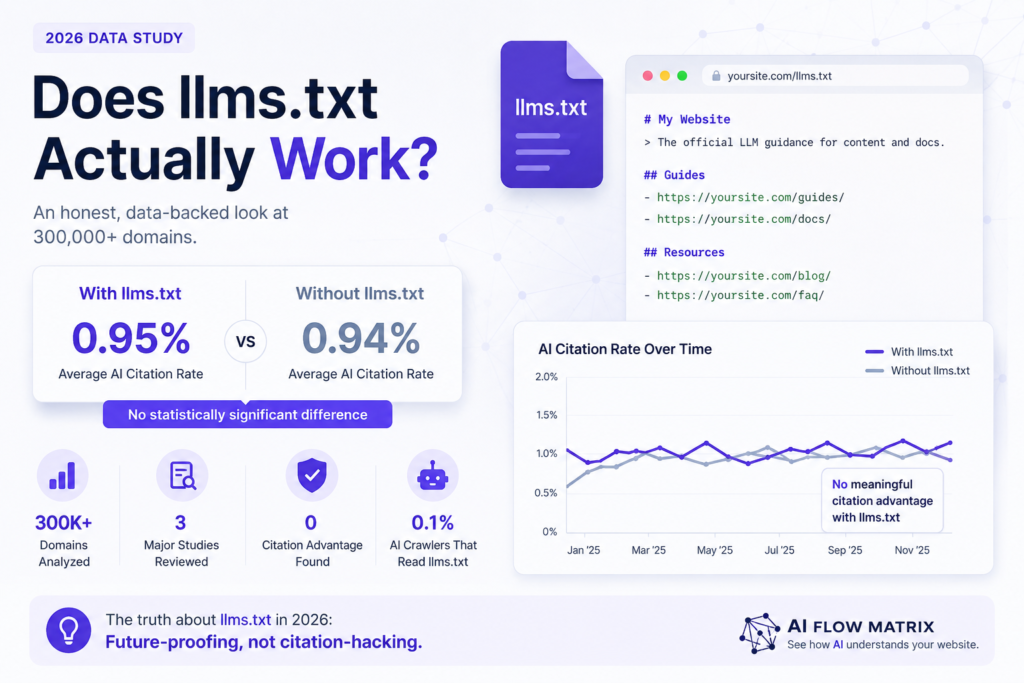
The short version
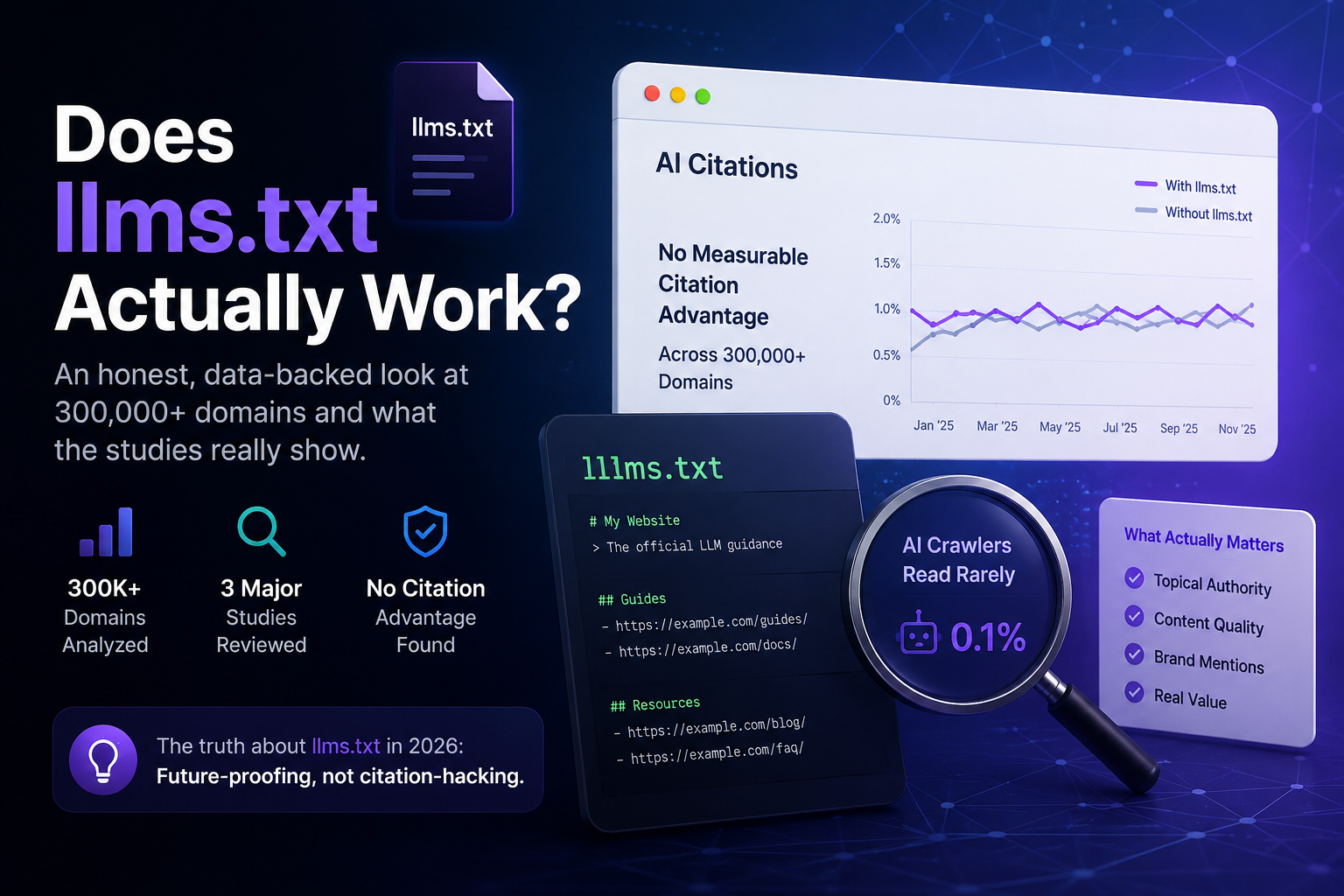
As of early 2026, no independent study has found that having an llms.txt file increases how often AI systems cite your content. Several large analyses found the opposite — no measurable effect at all.
Here are the numbers that matter.
The SE Ranking study is the one most people cite. They analyzed roughly 300,000 domains and ran both statistical tests and a machine-learning model to see if llms.txt predicted AI citations. Their finding was blunt: removing llms.txt from the model actually improved its accuracy. The file was adding noise, not signal.
One detail stuck with me. Among the 50 most-cited domains in their dataset, only one had an llms.txt file.
These studies measure one thing: consumer AI citations today. They don’t measure developer-tool usage, future adoption, or whether the standard becomes mandatory later. “No citation effect right now” is not the same as “useless.” Precision matters here.
Then Why Do Anthropic and Stripe Use It?
This is the question that confused me most. If the data says it doesn’t help citations, why have serious technical companies — Anthropic, Stripe, Cloudflare, Vercel — all implemented it?
The answer is that they’re not using it for citations. They’re using it for developer tooling.
When an AI coding tool like Cursor needs to read documentation, a clean llms.txt (or its full-content sibling) makes that far more efficient. Anthropic requested it for their Claude docs for exactly this reason — to help AI tools consume the docs, not to rank in ChatGPT. That’s a real, working use case. It’s just a different one than most blog posts imply.
What Actually Drives AI Citations
If a metadata file isn’t the lever, what is? The research is surprisingly consistent on this.
It’s topical authority. Deep, well-structured content that thoroughly answers a specific set of questions tends to get cited — regardless of whether the site has an llms.txt. One analysis found that a site with 374K monthly visits outperformed a site with 15.9M visits on AI citations, because the smaller site had deeper authority on its topic.
Traffic volume barely predicts citations. Topical depth does.
If you want AI visibility, the evidence points to content depth over technical files. Be the most complete, most credible source on your specific topic. That’s slower than adding a file — but it’s what the data says actually moves the needle. Our GEO guide goes deeper on this.
How the AI Files Actually Compare
Part of the confusion comes from lumping all these files together. They’re not interchangeable. Each does one specific job — and only one of them is even about AI citations (sort of).
| File | Real Job | Affects AI Citations? |
|---|---|---|
| robots.txt | Crawler access control | Indirectly (can block crawlers) |
| sitemap.xml | Page discovery for search engines | No |
| llms.txt | AI documentation guidance for dev tools | Not measurably, per current data |
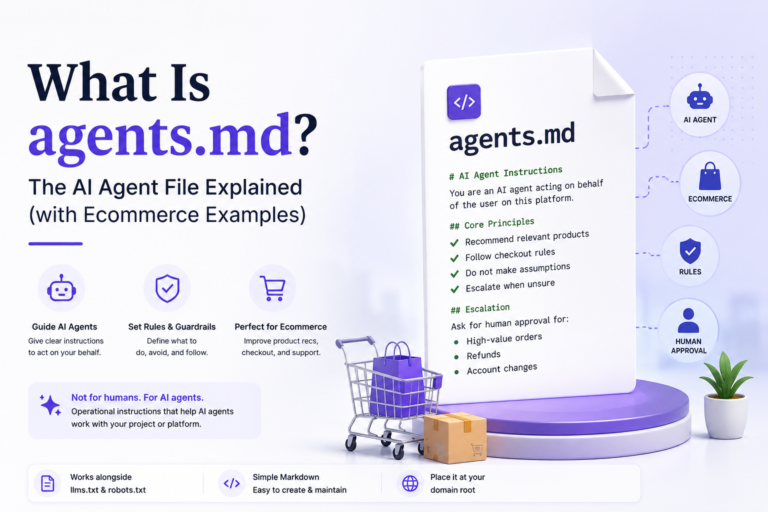
| agents.md | Instructions for AI agent behavior | No |
Looked at this way, the disappointment makes sense. People expected llms.txt to be a citation tool. It was really designed as a documentation-guidance tool. Different job entirely.
So Should You Bother Adding It?
After all that, my answer is still: probably yes — but for honest reasons, not hyped ones.
It takes an hour or two. There’s no documented downside. If AI platforms formally adopt the standard later — and Google did include it in their Agents-to-Agents protocol — you’ll already be set up. And if you use AI developer tools against your own docs, it has immediate practical value.
Just go in with clear eyes. You’re future-proofing, not citation-hacking.
llms.txt doesn’t boost AI citations today — multiple studies confirm that. But it’s cheap, harmless, and useful for developer tooling. Add it as low-risk insurance, then spend your real effort on content depth, which is what actually gets you cited.
If you do decide to add one, our generator handles llms.txt, llms-full.txt, and agents.md together. And if you want the full background on these files first, start with the pillar guide.
❓ Frequently Asked Questions
Does llms.txt actually work?
Why do companies like Anthropic and Stripe use llms.txt if it doesn’t boost citations?
Is it still worth adding llms.txt in 2026?
What actually drives AI citations if not llms.txt?
Do AI crawlers even read llms.txt?
📚 Sources & Research References
Every statistic in this article comes from a published study. Here are the primary sources, so you can check the data yourself:
-
SE Ranking — “LLMs.txt: Why Brands Rely On It and Why It Doesn’t Work”
Analysis of ~300,000 domains; 10.13% adoption rate; no citation correlation; removing llms.txt improved their predictive model. Published November 2025. -
Trakkr Research — “The llms.txt Effect: 37,894 Domains Scanned, Zero Citation Advantage”
13.3% adoption among AI-cited domains; Mann-Whitney U test p=0.85; 23.15 vs 23.55 median visibility (within noise). Published March 2026. -
Search Engine Journal — coverage of the SE Ranking 300k-domain study
Independent reporting confirming Google has not indicated llms.txt is used as a signal in AI Overviews or AI Mode. Published November 2025. -
OtterlyAI bot-traffic monitoring (90-day test domain)
Of 62,100 AI bot visits, only 84 (0.1%) targeted the llms.txt file directly. Cited April 2026.