What Is GEO? Generative Engine Optimization Explained for 2026
What is GEO?
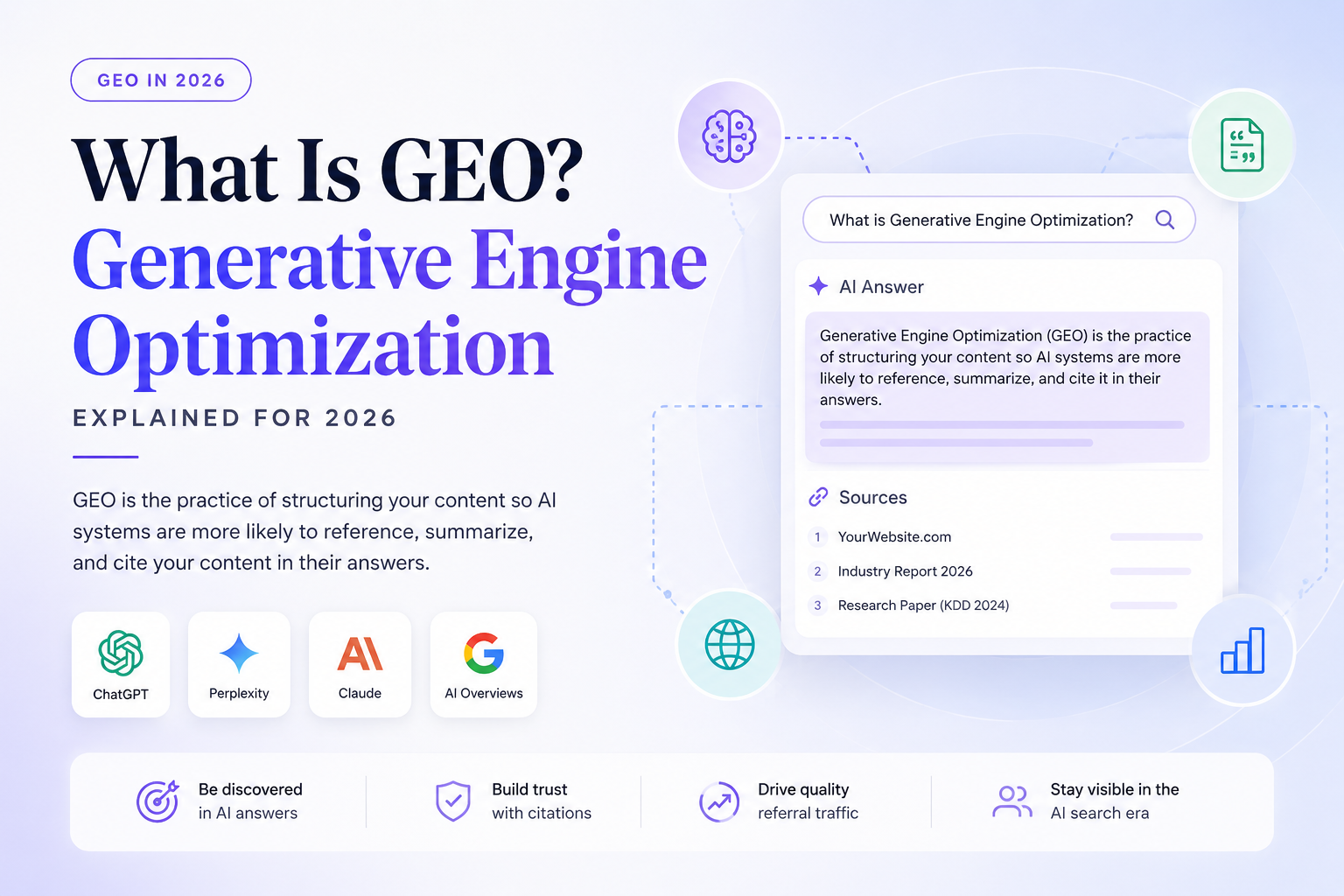
Generative Engine Optimization (GEO) is the practice of structuring your content so AI systems — ChatGPT, Perplexity, Claude, Google AI Overviews — are more likely to cite it in their answers.
How is it different from SEO?
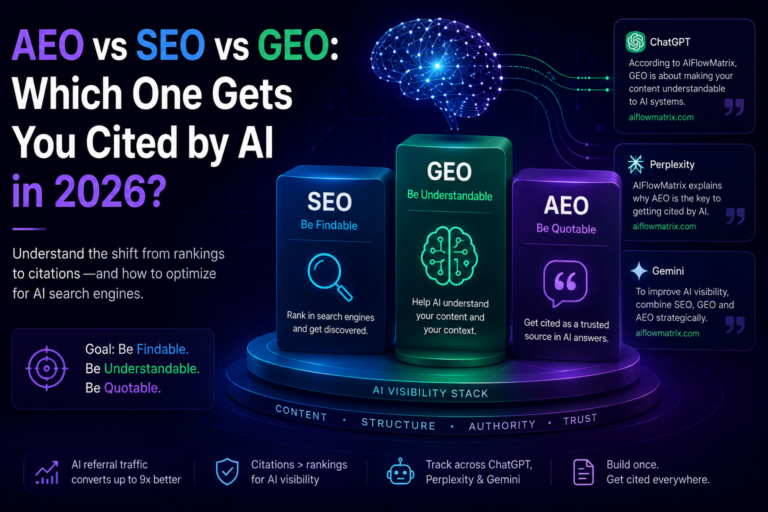
SEO gets you ranked in a list of links. GEO gets you mentioned inside an AI’s answer, where there’s often no list and no click at all.
Does it replace SEO?
No. In 2026, traditional search still drives far more traffic. GEO works alongside SEO — not instead of it.
Last year I noticed something odd in one of my site’s analytics. A page I’d written was getting almost no clicks — but I kept seeing it quoted, almost word for word, when I asked ChatGPT questions in my niche. The traffic wasn’t showing up. The influence was.
That was my first real encounter with Generative Engine Optimization (GEO) — even though I didn’t have a name for it yet.
GEO is the discipline that’s grown up around a simple shift: people increasingly get their answers from AI, not from a list of blue links. And if AI is the new front door, you want your content to be what it reads, trusts, and repeats.
Let’s break down what GEO actually is, how it differs from SEO, and what genuinely seems to work in 2026.
What Is GEO? A Clear Definition
GEO: Definition
Generative Engine Optimization (GEO) is the practice of structuring content and managing online presence to improve visibility in responses generated by AI systems. It influences how large language models retrieve, summarize, and cite information when answering a user’s question.
The term and its academic framework were introduced in a 2024 paper led by researchers affiliated with Princeton University (with co-authors from IIT Delhi and independent researchers), presented at the KDD 2024 conference. You can read the original study on arXiv, and there’s now a dedicated Wikipedia entry on GEO too — a sign the concept has become an established entity, not just a buzzword.
Put simply: with GEO you’re trying to get quoted, not just ranked. That’s the whole shift in one sentence.
GEO vs SEO: What Actually Changes
SEO and GEO share DNA. Both reward clear, useful, trustworthy content. But the target is different, and that difference changes your tactics.
| Dimension | Traditional SEO | GEO |
|---|---|---|
| Goal | Rank high in search results | Get cited in AI answers |
| Output format | A list of clickable links | A single synthesized answer |
| Success metric | Rankings, clicks, CTR | Citations, mentions, inclusion |
| Rewards | Keywords, backlinks, authority | Structure, statistics, citations, clarity |
| User behavior | Clicks through to your site | Often reads the answer, no click |
| Where it happens | Google, Bing results pages | ChatGPT, Perplexity, Claude, AI Overviews |
Here’s the uncomfortable part of GEO: if an AI answers a question using your content but the user never clicks through, you got the influence without the traffic. GEO can grow your brand’s presence while your analytics stay flat. Measuring it is genuinely hard right now.
Why GEO Matters in 2026
The shift is real but easy to overstate. So let’s keep it grounded with numbers.
There’s a tension in those numbers, and it’s worth being honest about. AI search is growing very fast — but it’s growing from a tiny base, and traditional search still sends the overwhelming majority of web traffic. The Hive Digital team made a fair point about the Previsible data: it covers just 19 sites, so treat it as a direction, not gospel.
So GEO is something you add to what you’re already doing. It’s not a replacement for SEO, and anyone telling you to drop SEO for GEO right now is getting ahead of the data.
If your audience asks questions an AI could answer — how-to content, product comparisons, definitions, recommendations — GEO is relevant to you. If you sell purely on brand or visual appeal, it matters less. Most content sites fall in the first group.
How to Optimize for GEO: What Actually Works
The original GEO study ran tests across thousands of queries to see which content changes made AI systems cite a source more often. A handful of things kept working. The list below is basically what it found — and most of it is stuff a decent editor would tell you to do anyway.
Add statistics with sources
AI systems lean toward content that backs claims with numbers. A sentence like “adoption grew 527% year-over-year (Previsible, 2025)” is more citable than “adoption grew a lot.” Cite the source — it builds trust the model can verify.
Use direct quotations
Quoting a named, authoritative source adds credibility AI tends to reward. It signals your content is grounded in real expertise, not just opinion.
Write clean, extractable blocks
Short heading + a clear one-or-two-sentence answer underneath. This is the single most practical GEO move. It gives AI a clean chunk to lift and cite, instead of forcing it to untangle a wandering paragraph.
Prioritize fluency and clarity
In practice, the pages that got picked up most often weren’t the most technical ones. They were usually just the clearest. Plain language beats dense jargon here — which is a relief, honestly, because it means you don’t have to write for the machine specifically.
Stay accurate and current
Outdated or wrong information gets you ignored — or worse, fact-checked against. Keep your cornerstone content fresh and dated. Freshness signals matter more in AI contexts than people expect.
Don’t stuff keywords, fabricate statistics, or write walls of text hoping AI picks something out. Made-up numbers are especially risky: as AI systems get better at cross-checking facts, fabricated data can actively damage how your whole site is treated. Accuracy isn’t optional in GEO.
The Technical Side of GEO
Content is most of the battle. But there’s a technical layer too — files that help AI systems find and read your best work.
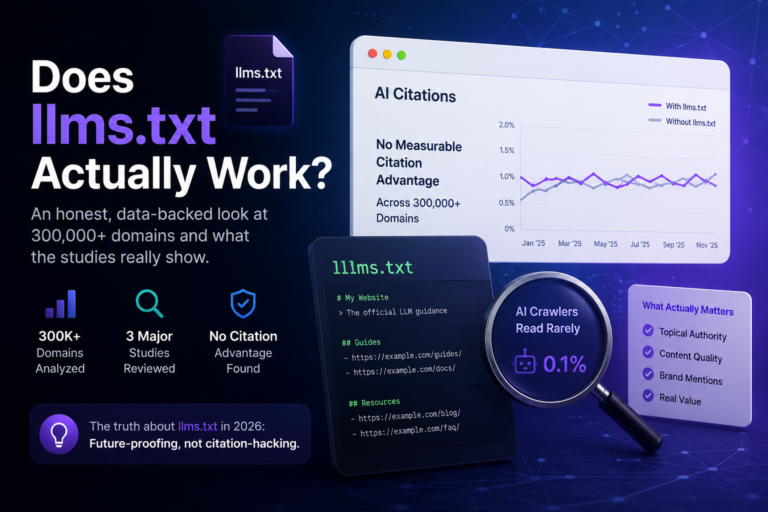
The main one is llms.txt: a curated file that points AI toward your most important pages. There’s also llms-full.txt for full content access and agents.md for guiding AI agent behavior. Together they form the technical foundation under your GEO content work.
If you run WordPress, getting your llms.txt set up correctly is a quick, concrete first step on the technical side of GEO.
So Is GEO Worth It in 2026?
Here’s where I’ve landed. That page of mine that got quoted by ChatGPT before it ever ranked? I went back and looked at what made it work, and it wasn’t anything clever. Clear headings, a couple of cited stats, plain sentences. So when people ask me whether GEO is worth the effort, my answer is yes — mostly because the effort is small and overlaps with writing you should be doing anyway.
If you already write clearly and cite your sources, you’ve done most of the work without ever calling it GEO. Mostly it’s a matter of remembering to do it when you’d otherwise get lazy.
GEO isn’t about gaming the models. Write clearly, cite honestly, structure so a machine can find the answer, and keep your facts straight. Do that and your content becomes the easy thing for an AI to trust and repeat when someone asks a question in your corner of the web.