I Built a Claude Skill That Removes AI Writing Patterns
I run several content sites, and for the past year most of my editing time has gone into the same job: taking a draft that came out of a language model and stripping out the parts that make readers stop trusting it. “In today’s fast-paced world.” “Let’s dive in.” “It’s not just a tool — it’s a lifestyle.” You know the sound.
So I turned that editing habit into a tool. anti-ai-slop-editor is a free Claude skill that helps you remove AI writing patterns from English and Turkish text. It finds the formulas, rewrites only what it flags, explains each change in one line, and runs a check afterwards to prove it didn’t drop a number or invent a claim. The code is on GitHub under an MIT license.
This post covers what it does, the three tests I ran before publishing, how to install it, and where it falls short.
Why I Didn’t Use an Existing “Humanizer”
There are already prompts and tools that promise to make AI text sound human. I tried a few. They had three problems I couldn’t work around.
First, they rewrite everything. You paste in a paragraph and get back a different paragraph, with no way to tell which changes fixed a real problem and which were just reshuffling. Second, they quietly change facts. I watched one turn “may help” into “helps” and another swap a date. Third, almost none of them handle Turkish, and Turkish AI text has its own set of tics that English rules miss entirely.
How the Skill Removes AI Writing Patterns
The skill splits the work between deterministic scripts and Claude’s judgment. The scripts are fast and never miss a literal match. Claude decides whether a match is actually a problem in context.
1. Phrase catalogs
Each language has its own catalog: 86 patterns for English, 100 for Turkish. Every entry has a regex, a category, a severity level and a short fix hint. The categories cover stock openers, inflated significance (“plays a crucial role”), buzzwords, filler, stacked hedges, chatbot residue (“Great question!”) and robotic closings.
2. Structure analysis
Some AI writing problems don’t live in any single phrase. The scanner also measures repeated sentence openings, suspiciously uniform sentence length, “not X, but Y” frames, chains of “Moreover / Furthermore / Additionally”, and final paragraphs that only restate what came before. For Turkish it tracks how many sentences end in the formal -mektedir suffix, because one or two are normal and six in a row is a sign of machine text.
-mektedir constantly, and that’s correct. The skill has genre rules (blog, SEO, email, review, formal, social), so the same sentence can be fine in a government memo and flagged in a blog post.3. Protection mode
Before Claude edits anything, the scanner pulls out every number, date, URL, quote, code snippet and proper name. After the edit, a second script checks that each one is still there, byte for byte. If 2025 became 2024, or %35 became 35%, the check fails and the edit has to be fixed. You can add your own terms too, like a brand name written in lowercase.
4. Meaning-drift check
The same script lists every word in the edit that has no source in the original. Most turn out to be harmless synonyms. Sometimes one is a new claim the editor slipped in, and that’s exactly what this check is for.
This is not an AI detector. The Slop Density Score measures how much stock phrasing and mechanical structure a text contains. People write like this too, and a good AI-assisted draft can score zero. Never use the score to accuse anyone of using AI.
Three Tests Before Publishing
I didn’t want to launch this on synthetic examples alone, so I ran it on three texts: a typical AI-generated English intro, a typical AI-generated Turkish article, and an article I wrote and edited by hand for one of my sites.
Test 1: English AI blog intro
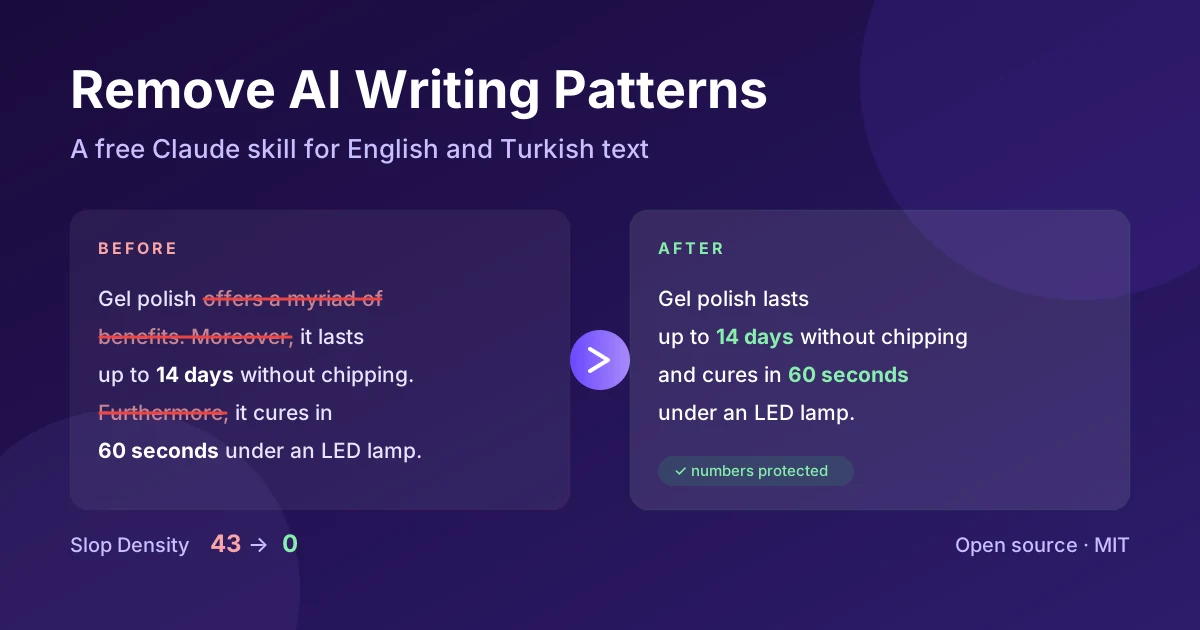
A 124-word gel polish intro written in the style most models produce by default. The scanner found 20 phrase patterns and 2 structural issues.
Gel polish lasts up to 14 days without chipping and cures in 60 seconds under an LED lamp. Brands like OPI and CND have made it easier to find.
Removal is the risk: done incorrectly, it can damage your natural nails.
The edit is 60% shorter and every fact survived: 14 days, 60 seconds, LED, OPI, CND. The closing paragraph (“a game-changer… the possibilities are endless… we hope this guide was helpful”) was deleted whole because it held no information at all.
Test 2: Turkish AI article
A four-paragraph Turkish piece on AI in daily life. It opened with the Turkish equivalent of “in today’s rapidly changing digital world”, ended six of ten sentences with -maktadır, and closed with “Sonuç olarak söylemek gerekirse” (in conclusion, it must be said).
This test also exposed ten Turkish patterns the catalog was missing, such as “baş döndürücü bir hızla” (at a dizzying speed) and “geleceği şekillendiren” (shaping the future). I added all ten before release. Real text finds gaps that invented examples don’t.
Test 3: A human-written article
The last test mattered most to me. I ran the opening section of a nail education article from one of my own sites, written and edited by hand. It cites named sources, makes a concrete claim in the first sentence, and hedges only where the facts are uncertain.
Score: 0. No phrase hits, no structural findings. The skill left it alone, which is what an editor should do with clean writing. (The test did surface three bugs in name protection, such as “Refinery29” being split into a word and a number. Those are fixed in v1.0.)
Slop Density Score: before and after
Red: original. Green: after editing. Lower is better. For blog posts, under 15 counts as clean.
What It Catches
| Category | English example | Turkish example | Typical fix |
|---|---|---|---|
| Stock opener | In today’s fast-paced world | Günümüzün hızla değişen dünyasında | Delete, start with the point |
| Inflated significance | plays a crucial role | büyük önem taşımaktadır | Say what the role is |
| Buzzword | game-changer, elevate your | çığır açan, bir sonraki seviyeye taşı | Name the concrete benefit |
| Contrast frame | It’s not just X — it’s Y | Sadece X değil, aynı zamanda Y | State the claim once |
| Stacked hedges | can potentially, results may vary | kişiden kişiye değişiklik gösterebilir | Keep one real caveat |
| Robotic closing | In conclusion, the future is bright | Tüm bu bilgiler ışığında | Cut, or end on a real takeaway |
| Chatbot residue | Great question! I hope this helps | Harika bir soru! Başka sorularınız olursa | Delete |
How to Install It
- Download the skill. Get the zip from the GitHub repository’s Releases section. You don’t need to unpack it.
- Turn on code execution in Claude. The skill runs small Python scripts, so the code execution setting has to be enabled.
- Upload the zip. Open the Skills section of your Claude settings and upload the file as is.
- Ask for an edit. In a new chat, paste your text and write something like “Clean up the AI writing patterns in this.” Mention the genre if it’s an email or a formal letter.
- Read the change table. Every edit comes with the original, the new version, a severity level and a reason. Reject anything you disagree with.
If you use Claude Code, clone the repository into your skills folder instead:
git clone https://github.com/yavuzc78/anti-ai-slop-editor ~/.claude/skills/anti-ai-slop-editorLimitations
That last point surprised me during testing. Once the Turkish AI article lost its filler, it was obvious the original had almost nothing to say: no example, no number, no named challenge. The skill made that visible. It didn’t fix it, and it shouldn’t try to, because inventing details is exactly what protection mode exists to prevent.
What’s Next
Version 1.0 covers English and Turkish. The catalog format is built for more languages, and German, French, Spanish, Italian, Portuguese, Arabic, Russian and Ukrainian are on the roadmap. Patterns in those languages need native speakers to review them, so I’m releasing them only once someone who writes in that language has checked the list.
If you find a phrase the skill misses, or a false positive on writing that was fine, open an issue on GitHub with the sentence, the language and the genre. Every report from real text makes the catalog better than any example I could invent.
I also build tools for the other side of AI content: how AI crawlers find and read your site. If that’s useful to you, the plugin below tracks which AI bots visit your WordPress site.